

Planning to start a local internet service and need an ISP business equipment list in Bangladesh? This guide is for new operators, cable and dish businesses moving into broadband, and technicians helping a client set up a point of presence (POP). The short answer: a small fiber ISP needs upstream bandwidth, a core router, a switch, an OLT with PON modules, a rack with an ODF, backbone and drop fiber, splitters and closures, customer ONUs, basic fiber tools and, very importantly, reliable backup power. Before buying anything, check the current licensing rules with the regulator, BTRC.
Start With Licensing and Upstream
Operating an internet service in Bangladesh requires the proper licence from the Bangladesh Telecommunication Regulatory Commission. Licence categories, fees and conditions change from time to time, so read the latest guidelines directly on the BTRC website or ask a consultant who handles ISP licensing. We do not give legal advice here; this article only covers equipment.
You will also need upstream bandwidth from a licensed provider (often called an IIG or a larger upstream ISP) delivered to your POP, usually over fiber. The size of that link, and whether you have a backup link, decides how many customers you can serve well at peak hours.
How a Small Fiber ISP Network Fits Together
It helps to picture the signal path before making a shopping list:
- Upstream fiber arrives at your POP.
- A core router (often MikroTik) handles customer logins, bandwidth plans, NAT and routing.
- A managed switch links the router, the OLT and any servers.
- The OLT converts Ethernet traffic into PON signals on its PON ports.
- Backbone fiber leaves the rack through an ODF and travels to the area you serve.
- Splitters in joint boxes divide each PON port's signal for many homes.
- Drop cable runs to each house, ending at the customer's ONU and router.
ISP Business Equipment List in Bangladesh: Item by Item
The table below is a starting checklist. We do not sell network equipment, so we name types and common examples only. Get several quotes from networking suppliers, because prices move with the dollar rate.
| Layer | Equipment | What it does | Buying tip |
|---|---|---|---|
| Core | Router (e.g. MikroTik RB5009, CCR2004) | PPPoE, bandwidth queues, routing, NAT | Size it for your peak customers, not today's count |
| Core | Managed switch | Connects router, OLT, servers | Gigabit ports plus SFP or SFP+ uplinks |
| Access | OLT (EPON or GPON) | Drives the fiber distribution network | Choose one technology and match ONUs to it |
| Access | PON and uplink SFP modules | Optical interfaces for OLT and switch | Check class (e.g. PX20, C+) and compatibility |
| Rack | Wall-mount or floor rack, ODF, patch cords | Holds and organises equipment and fiber | Leave space and airflow for growth |
| Outside plant | Backbone fiber, drop cable | Carries signal to the area and homes | Plan core counts for future expansion |
| Outside plant | PLC splitters, joint boxes, closures | Divides and protects fiber joints | Keep a splitting map from day one |
| Customer | ONU, optional Wi-Fi router | Ends the fiber at each home | Must match your OLT (EPON, GPON or XPON) |
| Tools | Fusion splicer, cleaver, OPM, VFL, stripper | Building and fixing fiber links | A good cleaver matters as much as the splicer |
| Power | Online UPS or IPS, LiFePO4 battery, mini UPS | Keeps POP and customers online in outages | Size backup for your longest local load shedding |
Core router and switch
The router is the brain of the ISP. Small operators commonly use MikroTik because RouterOS handles PPPoE servers, queues and hotspot in one box. Start with a model that can grow with you; we cover the options in more depth in our MikroTik guide. Add a managed switch with fiber uplinks so the router, OLT and any cache or billing server connect cleanly.
OLT and PON modules
The OLT is the biggest single choice after the router. EPON gear has been popular with small Bangladeshi ISPs for its lower cost, while GPON offers more downstream capacity and is widely used by larger operators. Whatever you pick, buy ONUs that match it, or choose XPON ONUs that can work with both.
Rack, ODF and patching
A tidy rack saves hours of troubleshooting. Use an ODF to terminate backbone fiber, label every port, and keep a printed diagram in the rack. Cheap patch cords and dirty connectors are a common cause of high loss.
Outside plant: fiber, splitters and closures
Plan routes along poles carefully, choose the right core count for backbone cable, and use closures that seal well against rain. PLC splitters (for example 1:8 and 1:16) let one PON port serve many homes; record each split so technicians can trace faults later.
Customer equipment
Each subscriber needs an ONU. Some ISPs give a Wi-Fi ONU; others provide a single-port ONU plus a separate router. Encourage customers to add a mini UPS, because a home that drops offline in every power cut calls your support line every day.
Fiber tools
Your technicians need a fusion splicer, cleaver, stripper, optical power meter and visual fault locator from the first day; an OTDR becomes important as the network grows.
Power Backup: The Item New ISPs Underestimate
In Bangladesh, the difference between a trusted local ISP and a frustrating one is often power. When your POP goes down in load shedding, every customer goes offline at once. Plan backup at three levels:
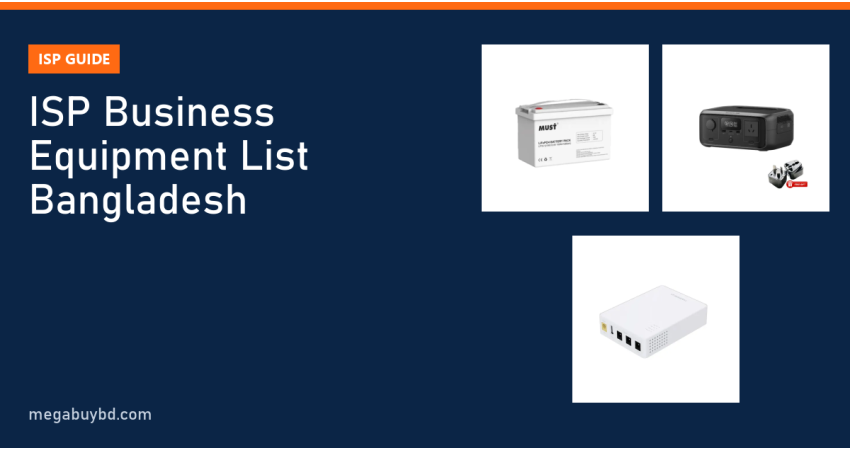
- POP: an online UPS or IPS with a deep-cycle battery bank. LiFePO4 batteries last many more cycles than lead-acid and need no water top-up, for example the Must LP15-12100 12.8V 100Ah LiFePO4 battery (Tk 26,500) or the Marsriva MR-LBP12-100-LAR 12.8V 100Ah (Tk 27,500). Check that your UPS or IPS supports lithium batteries before connecting.
- Small sub-POP or switch point: a portable power station with UPS mode such as the EcoFlow River 3 (Tk 27,000) can run a small switch or OLT for hours. See more in our power station category.
- Customer homes: a mini DC UPS for the ONU and router, from about Tk 1,390 for the MARSRIVA KP3 EC. Some ISPs bundle one with new connections. Our mini UPS buying guide helps customers pick the right one.
Prices are at the time of writing; product pages show the latest price.
How to Choose Equipment When Starting Small
- Pick one PON technology and stick with it for the OLT and ONUs. Mixing creates support headaches.
- Buy the router for year two, not month one. Replacing the core router later means downtime.
- Prefer equipment with local warranty and support, and keep one spare ONU, SFP module and patch cord set in stock.
- Spend on tools that save time: a reliable cleaver and power meter pay for themselves quickly.
- Budget for power before you budget for extra features.
- Document everything: fiber routes, splitter maps and customer ONU serials.
A Simple Starter Plan
A typical first phase for a neighbourhood operator might be: one MikroTik core router, one managed switch, a small OLT with a few PON ports, one wall rack with ODF, backbone fiber to two or three distribution points, 1:8 or 1:16 splitters, a batch of matching ONUs, a basic splicing kit, and a battery-backed UPS for the POP. Add capacity port by port as subscribers grow, rather than buying a large chassis on day one.
Related Guides
- Wifi Slow Hole Ki Korbo? 12 Easy Ways to Speed Up Home Wi-Fi
- Fiber Optic Tools List for ISP Technicians: Splicer, OPM, OTDR
- Best MikroTik Router for ISP: How to Choose by Network Size
- GPON vs EPON vs XPON ONU: Which One Should You Buy?
- Best WiFi Router for Home in Bangladesh: How to Choose (2026)
Frequently Asked Questions
Do I need a licence to start an ISP in Bangladesh?
Yes. Providing internet service commercially requires a licence from BTRC. Categories, fees and requirements are set by the regulator and can change, so always check the current information on the BTRC website or with a licensing consultant before you invest in equipment or sign customers.
Should a new ISP choose EPON or GPON?
Both work. EPON equipment has often been cheaper, which suits small operators, while GPON gives more downstream bandwidth per port and is common with larger providers. Compare total cost including ONUs, the support available from your supplier, and how many customers you plan per PON port.
What size UPS does an ISP POP need?
Add up the power draw of the router, switch, OLT and any servers, then multiply by the hours of backup you need for your area's longest outages. Choose an online UPS or IPS that can carry that load, with a battery bank sized for the hours. LiFePO4 batteries give a longer service life.
Which fiber tools should I buy first?
Start with a fiber stripper, a good cleaver, a fusion splicer, an optical power meter and a visual fault locator. These cover daily installation and most repairs. An OTDR is very useful for locating breaks on long backbone runs, and many operators add one as their network grows.
Buy ISP Backup Power from Megabuy BD
Searching for the ISP equipment price in Thakurgaon? Megabuy BD supplies authentic LiFePO4 UPS batteries, portable power stations and mini DC UPS units for POPs and customer homes. We deliver all over Bangladesh, including Thakurgaon (Thakurgaon Sadar, Pirganj, Ranisankail, Baliadangi and Haripur), with cash on delivery. Inside Dhaka, orders usually arrive in 24 to 48 hours. Browse our UPS battery collection for POP backup.



There are no comments for this Article.