

Which is the best MikroTik router for ISP use in Bangladesh? This guide is for small and growing local ISPs, cable operators moving into broadband, and network technicians who set up POPs. The short answer: for up to about 200 PPPoE users, a compact model like the hEX S or L009 can work; from roughly 200 to 500 users, the RB5009 or RB4011 is the practical middle ground; beyond 500 active users, or with 10G uplinks and heavy traffic, move to a Cloud Core Router such as the CCR2004 or CCR2116. Licence level, CPU, ports and power supply decide the right fit.
What a MikroTik Router Does in an ISP
MikroTik routers run RouterOS, a full-featured operating system that many Bangladeshi ISPs use as their core or edge router. In a typical small ISP, one MikroTik box handles:
- A PPPoE server that logs in each customer with a username and password.
- Bandwidth queues so each package gets its promised speed.
- NAT and routing between your customers and upstream bandwidth.
- Firewall rules, VLANs for different areas or OLTs, and sometimes Hotspot for Wi-Fi zones.
- Connection to a RADIUS or billing system.
Because the router touches every packet, picking one that is too small is the most common cause of evening slowdowns in a growing network.
How to Choose the Best MikroTik Router for an ISP
1. RouterOS licence level
Every MikroTik device ships with a RouterOS licence level that sets limits on tunnels and Hotspot users. According to MikroTik's official licence documentation, Level 4 allows 200 PPPoE tunnels and 200 active Hotspot users, Level 5 allows 500 of each, and Level 6 has no limit. For an ISP running PPPoE, this is the first spec to check.
2. CPU and RAM
PPPoE sessions, queues and firewall rules all use CPU. More cores and higher clock speed help, but real-world performance also depends on how you configure queues and firewall. More RAM helps with large routing tables and many connections.
3. Ports and uplinks
Count the ports you need for upstream, OLTs, switches and servers, and check for SFP or SFP+ cages. An SFP+ (10G) port lets you connect a fiber uplink or an OLT at more than 1 Gbps.
4. Power supply
Desktop models use an external adapter; Cloud Core Routers in this list have two power supplies so one can fail without downtime. Either way, plan a battery-backed UPS for the whole rack.
5. Form factor
Rack-mount models (with "RM" in the name or 1U chassis) keep a POP tidy. Small desktop boxes are fine for a first POP or a sub-POP in a shop corner.
Best MikroTik Router for ISP: Models Compared
The specifications below are taken from MikroTik's official product pages. We do not sell MikroTik equipment, so no prices are listed; get quotes from authorised networking suppliers, because prices follow the dollar rate.
| Model | CPU | RAM | Ports | Licence | Fits |
|---|---|---|---|---|---|
| hEX S (2025, E60iUGS) | 2 cores, 950 MHz | 512 MB | 5 x Gigabit, 1 x SFP (2.5G) | Level 4 | Very small ISP, sub-POP, office |
| L009UiGS-RM | 2 cores, 800 MHz | 512 MB | 8 x Gigabit, 1 x SFP (1G/2.5G) | Level 5 | Small rack-mount POP |
| RB5009UG+S+IN | 4 cores, up to 1.4 GHz (ARM64) | 1 GB | 7 x Gigabit, 1 x 2.5G, 1 x SFP+ (10G) | Level 5 | Growing ISP, a few hundred users |
| RB4011iGS+RM | 4 cores, 1.4 GHz | 1 GB | 10 x Gigabit, 1 x SFP+ (10G) | Level 5 | Growing ISP that needs many copper ports |
| CCR2004-16G-2S+ | 4 cores, 1.7 GHz | 4 GB | 16 x Gigabit, 2 x SFP+ (10G) | Level 6 | Mid-size ISP, unlimited PPPoE licence |
| CCR2116-12G-4S+ | 16 cores, 2 GHz | 16 GB | 13 x Gigabit, 4 x SFP+ (10G) | Level 6 | Larger ISP, heavy traffic, many queues |
Which MikroTik Should You Buy? Picks by Network Size
Up to about 200 users: hEX S or L009
For a new operator starting in one neighbourhood, a compact router keeps costs low. Remember the Level 4 licence on the hEX S caps PPPoE tunnels at 200, while the L009UiGS-RM has Level 5 and is rack-mountable. Treat this tier as a starting point and plan your upgrade path from day one.
About 200 to 500 users: RB5009 or RB4011
These two are popular middle-ground choices. The RB5009 has a newer 64-bit quad-core CPU, a 2.5G port and a 10G SFP+ port in a small case. The RB4011 offers ten gigabit ports in a rack-mount body. Both carry a Level 5 licence, which allows up to 500 PPPoE tunnels.
500 users and above: CCR2004 or CCR2116
Once you pass 500 active PPPoE sessions, you need Level 6, which the Cloud Core Routers include. The CCR2004-16G-2S+ is a sensible step up with two 10G ports and redundant power. The CCR2116-12G-4S+, with 16 cores and 16 GB of RAM, suits ISPs with heavy evening traffic, many queues or multiple upstream links.
A note on sizing
User count is only a rough guide. Total bandwidth, the number and type of queues, firewall complexity and features like Hotspot all affect load. Watch CPU usage at peak hours; if it is regularly high, plan the upgrade before customers notice.
Building Around the Router
- Switch: a managed switch with SFP+ uplinks between the router and OLTs.
- Billing and RADIUS: a separate server or cloud service so the router focuses on routing.
- Backups: export the RouterOS configuration regularly and store it off the device.
- Spare unit: keep a configured spare for your most critical router if budget allows.
- Power: the router, switch and OLT must stay on through load shedding.
Power Backup for Your MikroTik POP
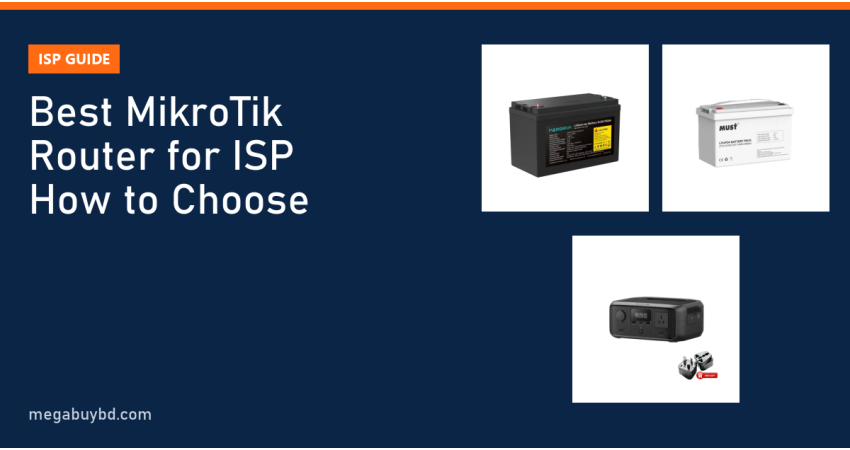
A Level 6 router is worthless if the POP goes dark every evening. For the rack, use an online UPS or IPS with a deep-cycle battery bank. LiFePO4 batteries offer many more charge cycles than lead-acid, for example the Marsriva MR-LBP12-100-LAR 12.8V 100Ah (Tk 27,500) or the Must LP15-12100 12.8V 100Ah (Tk 26,500). Confirm your UPS or IPS supports lithium batteries. Browse all options in our UPS battery category.
For a small sub-POP, a portable power station with UPS mode, such as the EcoFlow River 3 (Tk 27,000), can keep a desktop router and switch running. More models are in our power station category.
Before connecting any MikroTik to a DC mini UPS, check its input voltage. Some models need 24V or more, while many mini UPS outputs are 5V, 9V or 12V. Customer homes, on the other hand, are a perfect fit for a mini DC UPS on the ONU and router. Prices are at the time of writing; product pages show the latest price.
Related Guides
- Wifi Slow Hole Ki Korbo? 12 Easy Ways to Speed Up Home Wi-Fi
- ISP Business Equipment List in Bangladesh: What You Need to Start
- Fiber Optic Tools List for ISP Technicians: Splicer, OPM, OTDR
- GPON vs EPON vs XPON ONU: Which One Should You Buy?
- Best WiFi Router for Home in Bangladesh: How to Choose (2026)
Frequently Asked Questions
How many PPPoE users can a MikroTik router handle?
The licence sets a hard limit: 200 PPPoE tunnels at Level 4, 500 at Level 5 and unlimited at Level 6. The practical limit also depends on the CPU, the bandwidth per user, queues and firewall rules. Monitor CPU usage at peak time to see how much headroom you really have.
Is the RB5009 better than the RB4011 for an ISP?
The RB5009 has a newer 64-bit CPU, a 2.5G port and a 10G SFP+ port in a compact case. The RB4011 offers ten gigabit ports and a rack-mount body. Both have a Level 5 licence. Choose the RB5009 for performance per taka, or the RB4011 if you need many copper ports.
When should an ISP move to a CCR router?
Move to a Cloud Core Router when you approach 500 active PPPoE sessions, need more than one 10G uplink, or see CPU staying high at peak hours. The CCR models listed here also include redundant power supplies and a Level 6 licence, which removes tunnel limits.
Do I need a CCR to use a 10G uplink?
Not always. The RB5009 and RB4011 both have one SFP+ cage that accepts a 10G module, so a small ISP can take a 10G fiber link without a Cloud Core Router. Whether the router can actually push that much traffic with your queues and firewall is a separate question, so test carefully at peak time.
Buy POP Backup Power from Megabuy BD
Searching for the MikroTik router price in Thakurgaon? Megabuy BD sells authentic LiFePO4 UPS batteries, portable power stations and mini DC UPS units for ISP racks and customer homes. We deliver all over Bangladesh, including Thakurgaon (Thakurgaon Sadar, Pirganj, Ranisankail, Baliadangi and Haripur), with cash on delivery. Inside Dhaka, orders usually arrive in 24 to 48 hours.



There are no comments for this Article.