

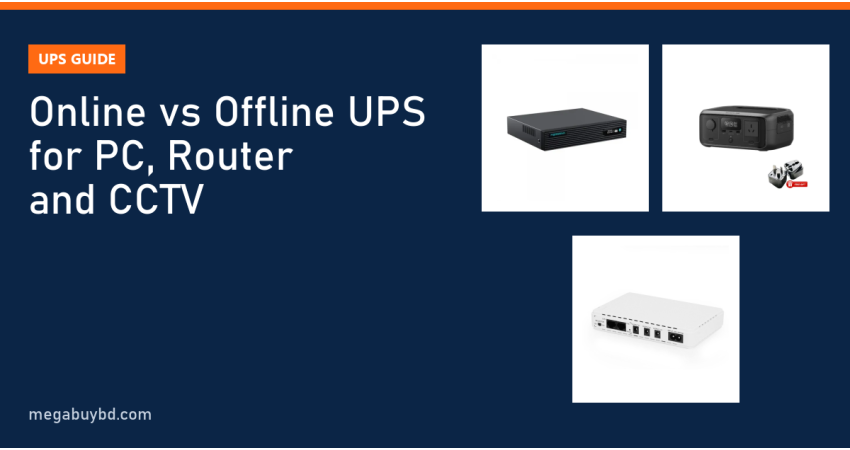
Need backup for a desktop PC, a WiFi router and ONU, or a CCTV recorder in Bangladesh? Here is the short answer on online vs offline UPS. An offline or line-interactive UPS is enough for most home and office PCs. A mini DC UPS is the best choice for a router and ONU. A small CCTV DVR works well on a line-interactive UPS, or on a DC UPS if the load is small enough. Pay for an online UPS only when equipment must never see a break: servers, a busy NVR, or round-the-clock recording where voltage is rough.
Online vs Offline UPS: What Happens When the Power Cuts
All three designs have a battery and an inverter. They differ in where your device draws power while mains is on, and how fast they react when it goes.
- Offline (standby): your device runs straight from the wall. When the UPS senses a cut, a relay switches the load to the inverter. Schneider Electric's white paper on UPS types calls this the most common design for personal computers.
- Line-interactive: also runs from the wall, but adds automatic voltage regulation (AVR). It corrects low or high voltage without using the battery. APC's Back-UPS BX650LI-MS, for example, is listed as line-interactive with a transfer time of 4 ms typical and 6 ms maximum.
- Online (double conversion): mains is turned into DC and the inverter rebuilds clean AC all the time, so a power cut causes no transfer. Eaton calls this zero transfer time.
| Point | Offline | Line-interactive | Online |
|---|---|---|---|
| Normal power path | Wall to device | Wall to device, through AVR | Always through the inverter |
| Break when power fails | A few milliseconds | A few milliseconds | None |
| Fixes low or high voltage | No, it goes to battery | Yes, without using the battery | Yes, fully |
| Output on battery | Often stepped (modified) sine | Stepped or pure sine, by model | Pure sine |
| Heat and running loss | Low | Low | Higher |
| Cost | Lowest | Low to medium | Highest |
Why a Few Milliseconds Matter (and When They Don't)
Transfer time vs your power supply's hold-up time
Intel's ATX12V design guide asks a desktop power supply to keep its outputs in spec for at least 17 ms after AC is lost at full load (hold-up time). A good offline or line-interactive UPS switches well inside that window. Trouble usually means a very cheap unit, a tired battery or a weak power supply.
Routers, ONUs and DVRs run from small adapters with little stored energy. A short gap can reboot them, and a router can take a minute or more to reconnect. That is one reason DC backup suits network gear.
Pure sine vs modified sine wave
Many budget UPS units output a stepped approximation of a sine wave on battery. Laptop chargers, router adapters and older PCs accept it for short runs. CyberPower notes that some modern active PFC power supplies can shut down on a stepped waveform. For a gaming PC or a PSU of 650 W and up, a pure sine UPS is the safer buy.
VA, Watts and How to Size the UPS
The real limit is the watt rating, not the VA on the box: Watts = VA x power factor. APC examples: the BX650LI-MS is 650 VA but 325 W, while the BX1500M is 1500 VA and 900 W. Our guide on which UPS to buy for a PC has typical PC and monitor wattages.
Step 1: load and rating
Load (W) = sum of every device's watts. Read the label or adapter (12 V 1 A = 12 W maximum) or use a plug-in power meter. Pick a UPS whose watt rating is at least Load x 1.25.
Step 2: backup time
Battery energy (Wh) = Volts x Ah x number of batteries. Lead-acid batteries give much less when drained fast, and the inverter loses some as heat. CSB's GP1272 (12 V 7.2 Ah) datasheet shows a 15-minute discharge at about 15.3 A, which is only about 3.8 Ah, roughly half the label.
Backup (hours) = Wh x k x e / Load (W), where k is the battery's usable share at that discharge speed and e is inverter efficiency. The k and e values below are assumptions for estimates; the UPS maker's runtime chart is always more accurate.
Worked examples (estimates)
- Example 1, home PC for online classes: 95 W PC + 20 W monitor = 115 W. Needed rating: 145 W or more, so a 650 VA model fits. With one 12 V 7.2 Ah battery (86.4 Wh), k = 0.5 and e = 0.85: 86.4 x 0.5 x 0.85 / 115 = 0.32 h, about 19 minutes.
- Example 2, router and ONU on a mini DC UPS: router 8 W + ONU 5 W = 13 W. Mini UPS mAh is quoted at cell voltage, so convert: 10,400 mAh x 3.7 V / 1000 = 38.5 Wh for a lithium-ion pack (LiFePO4 cells are 3.2 V). With e = 0.85 for the voltage converter: 38.5 x 0.85 / 13 = 2.5 hours.
- Example 3, 4-channel DVR with four analog cameras: Hikvision lists the DS-7104HGHI-K1 DVR at up to 16 W without a disk, a WD Purple 1 TB uses about 3.3 W, and a DS-2CE16D0T-IRPF camera is rated up to 4 W. Worst case with night IR: 16 + 3.3 + (4 x 4) = 35 W. The slower drain lets the battery give more, so assume k = 0.7: 86.4 x 0.7 x 0.85 / 35 = about 1.5 hours on one 7.2 Ah battery. See also our CCTV camera setup cost guide.
- Example 4, 8-channel PoE NVR: the datasheet for Hikvision's DS-7608NI-K1/8P (B) gives about 10 W for the NVR alone and a PoE budget of up to 75 W for the cameras. Plan for roughly 90 W before adding the router and switch.
Mini DC UPS: The Smarter Backup for Router and ONU
A router on a PC UPS turns battery DC into 220 V AC, and then the adapter turns it back to 12 V DC. Each step wastes energy. A mini DC UPS skips both and feeds 5, 9 or 12 V straight into the device, with no switchover gap. That is why a small pack can keep internet running for hours.
- Match voltage and plug to your adapter label; most ONUs and routers here use 12 V or 9 V.
- Know your PoE type. Standard PoE (IEEE 802.3af/at) runs at around 48 V. Many outdoor radios and some routers use 24 V passive PoE, and the two are not interchangeable.
In our range, the SKE POE 432P has 5, 9 and 12 V outputs plus 15/24 V PoE. The MARSRIVA KP9 Pro uses a LiFePO4 pack, has outputs up to 48 V, a PoE port and a 100 W maximum. It can carry a router plus a small PoE camera if the total watts fit. See all models in our mini UPS collection, and our mini UPS buying guide for more detail.
IPS vs UPS During Load Shedding
In Bangladesh, "IPS" usually means a home inverter with a large battery that runs fans and lights for hours. It is built for long runtime, not the fastest switchover, and transfer times differ widely between brands. Some offer a faster "UPS mode", but that label has no common standard. Practical rules:
- Laptops and mini DC UPS units are fine on an IPS. For a desktop, compare the IPS transfer time with the 17 ms hold-up figure, or put a small UPS between the IPS and the PC.
- For long outages, consider a power station with a UPS function. Retailers list the EcoFlow River 3 UPS switchover at under 10 ms, but some list 20 ms, so test it with your PC first.
Batteries: Lead-Acid vs LiFePO4 and How Long They Last
PC UPS units mostly use sealed lead-acid (VRLA) batteries, which Schneider Electric says usually last three to five years. It also gives a rule of thumb that every 8 °C rise above the ideal 20 to 25 °C halves battery life. In a hot room or a shuttered shop, expect to replace them sooner.
Mini DC UPS packs use lithium-ion or LiFePO4 cells. LiFePO4 is the longer-lasting, more heat-tolerant chemistry, also used in large IPS and solar batteries like those in our UPS battery section. Use these only with a lithium-ready inverter.
Safety Checklist
- Do not plug a laser printer, heater, iron or kettle into a UPS. APC advises against laser printers on any UPS outlet because their current surges can overload it.
- Plug the UPS into an earthed wall socket, not a loose multi-plug.
- Leave air space around the UPS, away from damp floors and direct sun.
- Replace any swollen, leaking or hot battery.
Recommendation Table: Device, UPS Type and Typical Size
| Device | Best UPS type | Typical size |
|---|---|---|
| Office or study PC + one monitor | Offline or line-interactive | 600 to 850 VA |
| Gaming PC or PSU 650 W+ | Line-interactive, pure sine | 1200 to 1500 VA, check watts |
| Office server, NAS or rack | Online (double conversion) | 1 kVA and up, sized to the load |
| Router + ONU | Mini DC UPS | About 8,000 to 20,000 mAh, by hours needed |
| 4-channel DVR + 4 analog cameras | Line-interactive, or DC UPS if within its watts | 600 to 650 VA, or a DC unit above 40 W |
| 8-channel PoE NVR + cameras | Line-interactive pure sine, or online for 24/7 business use | 1000 VA or more, after adding PoE load |
| Long load shedding (hours) | IPS or power station + UPS for PC | By Wh: load x hours |
How to Choose Between Online, Offline and Line-Interactive
- Add the watts of every device, counting PoE budgets and night IR in full.
- If your voltage often dips in the evening, skip plain offline and choose line-interactive.
- Choose online only when zero break is worth the extra cost and heat.
- Put network gear on a DC UPS and choose pure sine for active PFC power supplies.
Mini UPS and Power Station Price in Thakurgaon
Searching for the mini UPS price in Thakurgaon? Our product page prices are the same across Bangladesh. We deliver mini DC UPS units, power stations and UPS batteries across Thakurgaon district, including Thakurgaon Sadar, Pirganj, Ranisankail, Baliadangi and Haripur, with cash on delivery.
Frequently Asked Questions
Is an online UPS better than an offline UPS for a home PC?
It gives cleaner power and zero transfer time, but a home PC rarely needs it. A good line-interactive UPS switches faster than a standard power supply's hold-up time and corrects low voltage. Spend the difference on a pure sine model or a bigger battery unless you run a server.
Can I run my WiFi router on my computer's UPS?
Yes, but it is wasteful. Power goes through two conversions, and the router then shares the small PC battery with the computer. A mini DC UPS feeds the router directly at 9 V or 12 V. It usually gives several hours of internet from a much smaller battery.
What size UPS do I need for a 4-channel CCTV DVR?
Add the DVR, hard disk and cameras. A typical 4-channel set with 1080p analog cameras comes to about 30 to 40 W at night. A 600 to 650 VA line-interactive UPS carries that easily. A DC UPS rated well above that wattage at 12 V also works, if your cameras and DVR share a 12 V supply.
Why does my PC restart when the power goes, even with a UPS?
The usual causes are a worn battery that cannot hold the load, a UPS overloaded beyond its watt rating, or an active PFC power supply that rejects a stepped sine wave. Test with a lighter load. If the problem stops, the UPS or battery is too small; if not, try a pure sine UPS.
Buy from Megabuy BD
Megabuy BD sells authentic mini DC UPS units, portable power stations, LiFePO4 UPS batteries, routers and security cameras for load shedding. We deliver nationwide with cash on delivery, and Dhaka orders usually arrive within 24 to 48 hours.



There are no comments for this Article.