

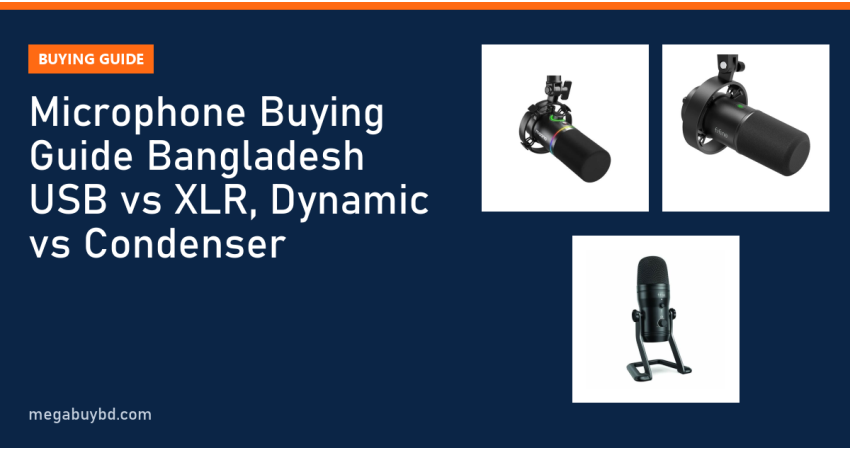
This microphone buying guide Bangladesh 2026 edition is for anyone who wants clearer sound for YouTube, podcasts, gaming, online classes or singing and is confused by terms like USB, XLR, dynamic and condenser. The short answer: most home users in Bangladesh should buy a USB or USB/XLR dynamic microphone with a cardioid pattern, because it ignores fan, traffic and neighbour noise better than a condenser. A good one from MAONO or FIFINE costs roughly 3,400 to 6,500 taka. Buy a condenser only if your room is quiet.
Below we explain each choice in plain language, match microphones to real uses, and list the MAONO and FIFINE models we sell with their prices at the time of writing.
USB vs XLR vs USB/XLR Hybrid Microphones
The connection decides what else you need to buy, so start here.
USB microphones
A USB microphone has its own preamp and converter inside. You plug it into a laptop or desktop, Windows or macOS detects it, and you can record. Most models also have a headphone jack so you can hear yourself with no delay, plus a gain knob and a mute button.
The limit: you cannot upgrade the sound later, and using two USB mics on one computer for a two-person podcast is awkward, because recording software usually takes one input device at a time.
XLR microphones
XLR is the three-pin connector used on stage and in studios. An XLR mic sends an analogue signal, so it needs an audio interface, mixer or sound card with a mic preamp before it reaches your computer. That costs more money and more desk space, but you can add a second mic, change the interface later or use the same mic on a stage PA system.
USB/XLR hybrid microphones
Hybrid mics have both a USB-C port and an XLR output. You start with USB today, and when you buy an interface or mixer later, you switch to XLR without replacing the microphone. For most buyers in Bangladesh this is the best value, and it is why models like the MAONO PD200X USB/XLR dynamic mic and FIFINE K688 sell so well.
Dynamic vs Condenser: The Choice That Matters Most at Home
This choice affects your sound more than price, brand or sample rate.
Condenser microphones
A condenser mic uses a very light diaphragm that reacts to tiny sounds. It captures detail, air and the natural tone of a voice or instrument. That sensitivity is also its weakness: it hears the ceiling fan, the AC, a pressure cooker in the kitchen, rickshaw bells and the echo of bare concrete walls. XLR condensers also need 48V phantom power from the interface. USB condensers get their power from the USB cable.
Dynamic microphones
A dynamic mic uses a heavier moving coil. It is less sensitive, so it mainly picks up a loud sound close to it, which is your mouth at 5 to 10 cm. Sounds from across the room are much quieter in the recording. They are also tough and need no phantom power. The trade-off is that you must speak close to the mic, and XLR dynamics need a fair amount of preamp gain.
Which one for a Bangladeshi home?
Think about where you will actually record. A typical flat in Dhaka, Chattogram or a district town has hard walls, tiled floors, a ceiling fan running for most of the year, and street noise through the windows. In that room a dynamic mic will usually sound cleaner. Choose a condenser if you record in a quiet, furnished room, sit at a distance from the mic, or record singing, recitation or instruments where detail matters more than noise.
Polar Patterns Explained
A polar pattern shows which directions a microphone listens to.
- Cardioid: picks up mainly from the front and rejects the back. Best for one person talking or singing. Almost every MAONO and FIFINE mic for creators is cardioid.
- Supercardioid: narrower at the front, with a small pickup zone directly behind. Common on stage mics.
- Omnidirectional: picks up equally from all sides. Good for a group around a table, poor in a noisy room. Most clip-on lavalier mics are omni.
- Bidirectional (figure-8): picks up front and back, rejects the sides. Useful for two people facing each other across one mic.
Some USB condensers, like the FIFINE K690, offer several patterns with a switch, so one mic can handle solo voice, interviews and group recording.
Sample Rate and Bit Depth: How Much Do You Need?
USB microphones list numbers like 16-bit/48kHz or 24-bit/192kHz. Here is what they mean in practice:
- Sample rate is how many times per second the sound is measured. 44.1kHz is the CD standard and 48kHz is the standard for video, YouTube and streaming. Both already cover the full range of human hearing.
- Bit depth sets the dynamic range. 24-bit gives far more headroom than 16-bit, so a recording made a little too quiet can be raised later with less added noise.
For voice, 24-bit/48kHz is more than enough. A 192kHz rating does not make speech sound better in a noisy room. The capsule, the pattern, the room and how close you speak matter far more than the biggest number on the box.
What Else You Need to Buy
Boom arm or stand
Small desk tripods put the mic too far from your mouth and pick up every keyboard tap. A boom arm brings the mic close to your face and off the desk. Our MAONO AU-B01 boom scissor arm costs 1,200 taka at the time of writing. Some kits, like the MAONO AU-A04 bundle, already include one.
Pop filter or foam windscreen
Words with "p" and "b" push a burst of air into the mic and cause a thump. A pop filter or foam cover stops it. Many mics include one; check the box contents before buying separately.
Audio interface or mixer for XLR
An XLR mic needs a preamp. For streaming and podcasts, a combined mixer and sound card like the Maonocaster AMC2 NEO (4,900 taka at the time of writing) offers XLR input, 48V phantom power and up to 60dB of gain, which suits low-output dynamic mics. If you only ever record yourself on a laptop, a USB or hybrid mic in USB mode is simpler.
Phone adapters
Many USB-C mics work with Android phones that support USB OTG, and with iPhone 15 and later models, which have USB-C. Older iPhones need Apple's Lightning to USB camera adapter. If you mainly film on a phone, a wireless lavalier is usually easier than a desk mic.
Which Microphone for Which Use
YouTube voice-over and tutorials
A USB or USB/XLR dynamic mic on a boom arm, 5 to 10 cm from your mouth. If your room is quiet and has curtains and furniture, a USB condenser like the FIFINE K669B gives a brighter, more detailed voice for less money. Our YouTube and podcast studio starter guide covers lights and cameras too.
Podcasts
For solo shows, any good cardioid dynamic works. For two or more hosts, use one mic per person. Hybrid mics let you start with one on USB and move both to XLR on a mixer when the second host joins.
Gaming and live streaming
Look for a quick mute button, headphone monitoring and a mic that ignores keyboard clicks. A dynamic mic on a boom arm is ideal. Gaming models with RGB lighting, like the FIFINE AmpliGame AM8 or MAONO DGM20, are popular with streamers who want the mic to look good on camera.
Online classes, Zoom and office calls
Teachers, students and freelancers on Zoom or Google Meet need a mic that is clear and simple. A budget USB mic with a gain knob is enough. A dynamic model helps if you teach from a busy home.
Mobile video and vlogging
For recording on a phone, use a clip-on wireless lavalier. Options we sell include the WiWU Wi-WM006 (2,750 taka) and Ulanzi A21 (3,500 taka), or the wired Boya BY-M1 (950 taka) for phones and cameras with a 3.5mm input. Read our wireless microphone buying guide for more detail.
Singing, recitation and waz recording
For singing, Quran recitation or naat in a quiet room, a condenser captures the voice's tone and detail better. For waz, sermons or talks recorded in a hall with a crowd and loudspeakers, a dynamic handheld or desk mic is the safer choice, because it rejects the room. For live stage work, an XLR dynamic into the mixer is the standard setup.
Microphone Price in Bangladesh: Budget Tiers in Taka
Looking for the best microphone in BD for your budget? Prices below are Megabuy BD prices at the time of writing. The product page always shows the latest price. For our full range, see microphone price in Bangladesh.
Under 3,000 taka
Entry USB condensers such as the MAONO AU-PM461TR (2,400 taka), FIFINE AmpliGame A6V (2,590 taka) and FIFINE K669B USB microphone (2,900 taka). A big step up from a laptop or earphone mic, best in a quiet room.
3,000 to 5,000 taka
The MAONO PD100U USB dynamic (3,400 taka) is the cheapest way into a dynamic mic. The Maono AU-A04 boom arm bundle (4,000 taka) is a USB condenser kit with an arm included, and the MAONO PD200X (4,700 taka) adds XLR for future upgrades. This is the sweet spot for most buyers.
5,000 to 8,000 taka
Better build, more controls and more choice: FIFINE AmpliGame AM8, FIFINE K688 USB/XLR dynamic, FIFINE AmpliTank Tank3, the four-pattern FIFINE K690 USB condenser, MAONO PD300X and the XLR-only FIFINE AmpliTank Tank1.
8,000 taka and above
The MAONO PD400X (9,800 taka) is a strong upper-mid USB/XLR dynamic. Above that sit professional broadcast mics such as the Shure MV7+ and Shure SM7B, which make sense when audio is your income.
MAONO and FIFINE Microphones Compared
The table lists the MAONO and FIFINE models we stock that most buyers ask about. Browse every model on our MAONO microphone and FIFINE microphone pages.
| Model | Type | Connection | Best for | Our price (at time of writing) |
|---|---|---|---|---|
| MAONO AU-PM461TR | Condenser, cardioid | USB | First mic, online classes | 2,400 taka |
| FIFINE AmpliGame A6V | Condenser, cardioid | USB-C | Budget gaming, RGB setup | 2,590 taka |
| FIFINE K669B | Condenser, cardioid | USB | Zoom, voice-over in a quiet room | 2,900 taka |
| MAONO DGM20 | Condenser, cardioid | USB | Gaming chat, streaming | 3,100 taka |
| MAONO PD100U | Dynamic, cardioid | USB-C | Noisy rooms on a small budget | 3,400 taka |
| MAONO AU-A04 bundle | Condenser, cardioid | USB | YouTube starter kit with boom arm | 4,000 taka |
| MAONO PD200X | Dynamic, cardioid | USB-C + XLR | Podcast, streaming, future upgrade | 4,700 taka |
| FIFINE AmpliGame AM8 | Dynamic, cardioid | USB-C + XLR | Streaming with RGB | 5,700 taka |
| FIFINE K688 | Dynamic, cardioid | USB + XLR | Podcast, voice-over, untreated rooms | 6,000 taka |
| FIFINE AmpliTank Tank3 | Dynamic, cardioid | USB-C + XLR | Streaming, teaching, quick mute | 6,090 taka |
| FIFINE K690 | Condenser, four patterns | USB | Interviews, groups, music | 6,300 taka |
| MAONO PD300X | Dynamic, cardioid | USB-C + XLR | Upgraded podcast setup | 7,300 taka |
| FIFINE AmpliTank Tank1 | Dynamic, cardioid | XLR only | Interface or mixer users | 7,900 taka |
| MAONO PD400X | Dynamic, cardioid | USB-C + XLR | Serious podcast and broadcast | 9,800 taka |
Want our picks within each brand? See the best MAONO microphone in Bangladesh, the best FIFINE microphone in Bangladesh, and our MAONO vs FIFINE microphone comparison.
Common Mistakes When Buying a Microphone
- Buying a condenser for a noisy room. It will record the fan and the street clearly. Fix the room or choose a dynamic.
- Speaking too far from the mic. Distance adds room echo. Keep a hand's width away, especially with dynamics.
- Buying an XLR-only mic with no interface. It will not plug into a laptop on its own.
- Turning the gain to maximum. High gain raises background noise and causes distortion when you laugh or shout. Set it so normal speech peaks well below the red.
- Talking into the wrong side. Many condenser mics are side-address and record from the side, not the top. Check the manual.
- Choosing by sample rate alone. A 192kHz label does not fix a bad room.
- Skipping headphone monitoring. Listening while recording catches problems early.
Microphone Buying Guide Bangladesh: How to Choose (Checklist)
- Where do you record? Noisy or echoey room: dynamic. Quiet, furnished room: condenser is fine.
- What do you plug into? Laptop only: USB or hybrid. Mixer or interface: XLR or hybrid. Phone: USB-C mic with OTG, or a wireless lavalier.
- How many people? One: cardioid. Two or more: one mic each, or a multi-pattern mic.
- Will you upgrade? If yes, buy a USB/XLR hybrid now.
- Controls you will use: gain knob, mute button, headphone jack.
- Accessories: boom arm, pop filter, cable length. Check what is in the box.
- Budget: plan for the mic plus arm, and an interface if you choose XLR.
- Buy authentic: fake copies of popular mics exist. Buy from a seller who shows clear prices and model names.
Microphone Price in Thakurgaon
Megabuy BD delivers microphones all over Bangladesh, including Thakurgaon Sadar, Pirganj, Ranisankail, Baliadangi and Haripur, with cash on delivery. Creators, teachers and students in Thakurgaon pay the same price as on our website, so you can compare MAONO and FIFINE models online and order to your door.
Frequently Asked Questions
Which microphone is best for YouTube in Bangladesh?
For most home creators, a USB or USB/XLR dynamic mic on a boom arm is the best choice, because Bangladeshi rooms often have fans, echo and street noise. The MAONO PD200X and FIFINE K688 are popular picks. If you record in a quiet, furnished room, a USB condenser such as the FIFINE K669B also works well.
Is a USB microphone good enough for a podcast?
Yes. A good USB microphone records clean, broadcast-ready voice for a solo podcast without any extra equipment. The difficulty starts with two or more hosts on one computer. In that case, buy USB/XLR hybrid mics, so you can later connect them all to a mixer or audio interface through XLR.
Do I need an audio interface for a USB/XLR microphone?
Not at first. In USB mode the mic connects straight to a laptop or desktop and works on its own. You only need an audio interface or mixer when you want to use the XLR output, for example to add a second mic, use better preamps, or connect to a stage or streaming mixer.
Can I connect a MAONO or FIFINE USB microphone to my phone?
Often yes, but it depends on the phone. Android phones that support USB OTG usually work with USB-C mics, sometimes with an adapter. iPhone 15 and later have USB-C, while older iPhones need Apple's Lightning to USB camera adapter. For filming on a phone, a wireless lavalier mic is usually more practical.
Buy from Megabuy BD
Megabuy BD sells authentic MAONO, FIFINE, Boya, Ulanzi, WiWU and Shure microphones with clear prices on every product page. We deliver nationwide with cash on delivery, and Dhaka orders usually arrive within 24 to 48 hours. Message our team for help choosing a microphone.



There are no comments for this Article.